Although the sailor genes in our family seem to come from Jennie Evans and her parents, there is also a possibility that the Charters were also boaters or boat-builders. I'm trying to work out if we are any relation to the John Charters who in 1846 was listed as working at Tinning's Wharf. This wharf was founded around 1830 by R. Tinning and was at the foot of what is now called York Street; it was demolished in 1886 by the CPR according to the Toronto Historical Association.
Tinning's Wharf also has its own interesting history. R. Tinning was one of the first in the city to make lifeguarding and water safety an important priority. His wharf was the port of call for steamboats that took Toronto passengers on daytrips to Niagara Falls. Recently its remains were discovered during a dig for a new condo building.
The photo below was taken around 1890 at the wharf at the foot of Yonge Street. The steamer is the Macassa, which went to Hamilton. The Toronto custom-house was also at the foot of Yonge Street in 1846: I imagine this was probably where many of the boats came in from the US.
I'm not sure how to find out if John Charters was a relative. So far I've just started to map out his family. John had a son, Thomas Charters, who became a moulder, and who worked at the same foundry as William Blashford in 1866. He also had two daughters. There was also another relation who lived with them, Charles Charters, who was a carpenter like John, but he seems to disappear after 1866.
Families and Histories
Saturday, February 7, 2015
The Charters and Boats (II)
Labels:
boats,
Charters,
Evans,
family history,
geneaology,
steamer,
Toronto,
wharf
Schools and Gyms: William Charters and his son
We know quite little about William Charters, my great-great grandfather. However on his death certificate it says he worked as a school caretaker. The 1895 City Directory also shows that he worked at Park School.
Park School has now been demolished, but it was built in 1877 (designed by Frank Darling, who also built Convocation Hall) and it was at the junction of St Davids Street and Sackville Street (near Queen and River today).
At the time, William Charters was 57 and was living at 267 Seaton Street with his son William Chesteain Charters, age 25.
William Charters seems to have started working at Park School sometime after 1889, because in that year the City Directory listed him as an expressman. His son William C Charters, who was twenty years old, is listed as "instructr gymnasium."
Park School has now been demolished, but it was built in 1877 (designed by Frank Darling, who also built Convocation Hall) and it was at the junction of St Davids Street and Sackville Street (near Queen and River today).
At the time, William Charters was 57 and was living at 267 Seaton Street with his son William Chesteain Charters, age 25.
William Charters seems to have started working at Park School sometime after 1889, because in that year the City Directory listed him as an expressman. His son William C Charters, who was twenty years old, is listed as "instructr gymnasium."
The Charters and boats (I)
My grandfather Harvey Charters was an avid sailor and canoeist. According to my grandmother, it was Harvey's mother, Jennie Evans, who taught him to paddle. Her father, Alfred Evans, was a boat-builder from England.
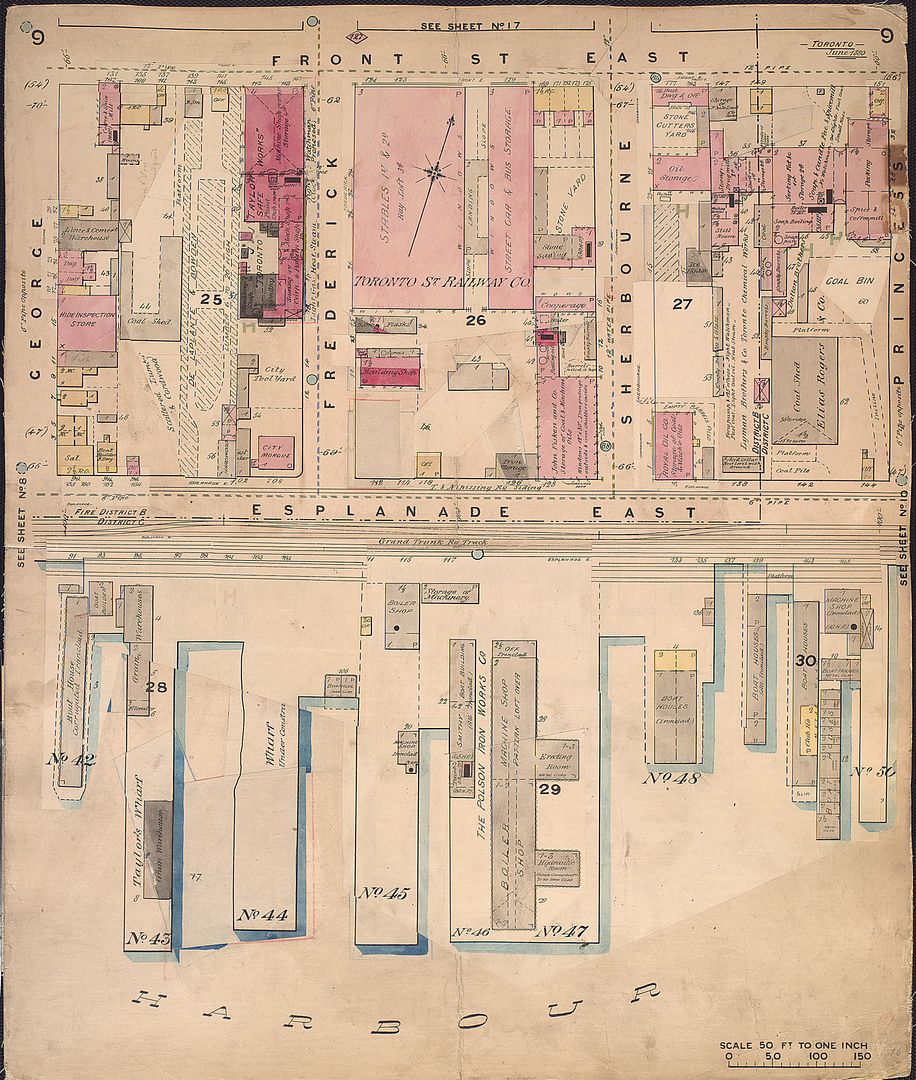
The city directory of 1877 lists Alfred Evans as a boat-builder, with his workplace on Esplanade at the foot of Princess Street.
These days the south side of the Esplanade is land, but in the nineteenth century it was still water. Alfred worked on the south side of the street. In fact, here is a city plan from 1889 showing how the south sides of the lots are surrounded by the lake. Princess Street is at the far right of the map.
| (Digitzed map from Photobucket) |
What did the area look like at the time? It was pretty industrial! Here is a photo of the Esplanade and Berkeley Street, further west.
| Photo from Torontoist and City of Toronto Archives |
One of Alfred's relations may have been William Evans, who according to the 1866 Toronto directory was living at 76 Elm Street and whose profession was listed as "mariner." Perhaps it is also just a complete coincidence, but in 1866, Richard Blashford was also living on Elm Street, at No. 82. Richard Blashford was Joseph Charters's uncle; Joseph Charters was the man who married Jennie Evans. The only Willie Evans in my family tree, however, is Alfred's only son, born in 1889, who did not survive his first year.
Friday, February 6, 2015
Edward Street: Row house to bowling alley
William Charters, the Blashfords, and the Captains, all lived at 26-28 Edward Street at one point. This address is on the north side of the street between Bay and Yonge Street. In the 1930s these houses were knocked down to build a bowling alley; after that, the bowling alley was turned into the World's Biggest Bookstore. Next door (just west of the WBB) is the BMV bookstore, at 10 Edward Street, so it seems fairly clear that the WBB occupied the space where their house was. It was probably a row house like the ones you see below in the picture of Bay and Edward in 1923.
Further west of here, at the corner of Chestnut Street, was Angelo's Tavern (below).
Here is another view from 1952, after the bowling alley was built, and looking west along Edward Street from Yonge Street.
You can see from the archival picture above that the older buildings just east of the bowling alley on Edward Street were not demolished right away. Here is a look at 10 Edward Street today.
Further west of here, at the corner of Chestnut Street, was Angelo's Tavern (below).
![]() |
| Source: Toronto Public Library |
Here is another view from 1952, after the bowling alley was built, and looking west along Edward Street from Yonge Street.
![]() |
| Source: Lost Toronto |
You can see from the archival picture above that the older buildings just east of the bowling alley on Edward Street were not demolished right away. Here is a look at 10 Edward Street today.
Labels:
Angelo's,
Bay Street,
bookstore,
bowling,
Charters,
Chestnut,
Edward,
Toronto history
Thursday, February 5, 2015
A Ticket to Ryde: Holiday Hats on the Isle of Wight
Holiday camps seem to have been a fixture of the 1950s judging from the family album on the Gorst side. This a a fashion parade in 1959 at an Isle of Wight holiday camp. Granny (Olga Gorst), 5th from the right, is wearing a hat entitled "Lonely petunia in an onion patch" (which is a song from the 1940s), see below.
Granny's older sister Cath, on her right, has the "Carmen Miranda" hat. Sis, second from the left, has something called "A Ticket to Ryde." Ryde is a place on the Isle of Wight but there are about five holiday camps nearby, so I don't know how I'd narrow down which camp they were at. Here's Granny's petunia patch hat song:
Both of Granny and Cath's hat choices are themed from the 1940s. Carmen Miranda had a song specifically about The Lady in the Tutti Frutti Hat, and this is from a 1943 musical. Maybe their fashion parade was themed for 1940s musicals...?
Ryde pier on the Isle of Wight is now 200 years old. This photo below looks like it's from 1950 perhaps?
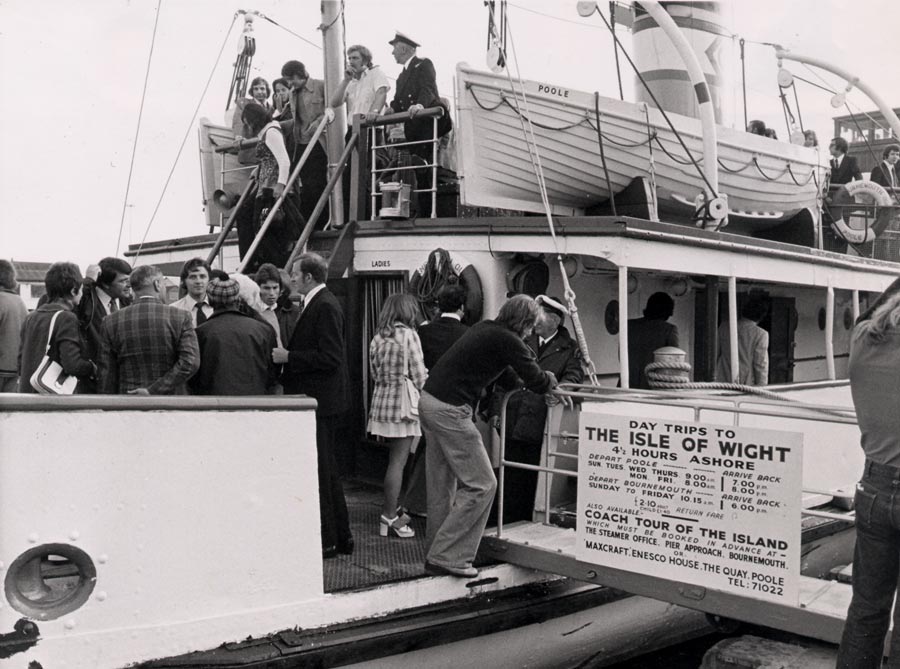
The photo below is of Bournemouth, where they might have got the ferry to the island--looks like it was taken maybe in the 1960s.
Granny's older sister Cath, on her right, has the "Carmen Miranda" hat. Sis, second from the left, has something called "A Ticket to Ryde." Ryde is a place on the Isle of Wight but there are about five holiday camps nearby, so I don't know how I'd narrow down which camp they were at. Here's Granny's petunia patch hat song:
Both of Granny and Cath's hat choices are themed from the 1940s. Carmen Miranda had a song specifically about The Lady in the Tutti Frutti Hat, and this is from a 1943 musical. Maybe their fashion parade was themed for 1940s musicals...?
Ryde pier on the Isle of Wight is now 200 years old. This photo below looks like it's from 1950 perhaps?
The photo below is of Bournemouth, where they might have got the ferry to the island--looks like it was taken maybe in the 1960s.
| Photo from Photo-Sleuth |
Labels:
Bournemouth,
Cath,
holidays,
Isle of Wight,
Olga,
Ryde
Which Church for the Charters? (I)
We know that William Charters, who was always listed as Irish on the censuses, was listed as a Baptist in the censuses. Below is the Bond Street Baptist church, the earliest Baptist church in Toronto, built in 1832.
William arrived in Toronto around 1850-1860, possibly after fighting raids by the Fenians. So where did he and his family worship?
The Bond Street Baptist church (above) was the earliest White Baptist church in the city. It was founded around the time William was born and was southeast of where he lived, at Queen and Shuter.
There were also African Baptist churches in Toronto. These are relevant because although the family in Toronto (now) identifies as White, there are separate family rumors (1) that William and Ann Captain were runaway slaves and (2) the Charters had Black relatives. Below is a photo of the First Baptist Church, founded in 1841, an African-American church. From 1841 on, this church was at the corner of Victoria and Queen Street. In 1905 the church moved to Edward and University Street.
Lucy White (Mary's mother) was usually listed as a Baptist on the censuses, as were the Captains, but she was listed as a Methodist in 1891. So I've also been looking into the English and African Methodist churches as well. There was the African Methodist Episcopal Church (AME) below, which was at Elm Street at one point. AME was founded in 1816.
The Elm location for AME is interesting because, in the 1866 directory, William Blashford's home is listed as 34 Elm Street, but 34 Elm Street was actually vacant lots next to the AME church. At the time he was working as a machinist at 22 Beverley Street; Thomas Chartres, a machinist, also worked there.
His father Richard Blashford worked near the AME church as a tailor at 82 Elm Street, in 1866, and William Evans, "mariner," lived at 76 Elm in 1866.
| Source: Toronto Public Library |
William arrived in Toronto around 1850-1860, possibly after fighting raids by the Fenians. So where did he and his family worship?
The Bond Street Baptist church (above) was the earliest White Baptist church in the city. It was founded around the time William was born and was southeast of where he lived, at Queen and Shuter.
There were also African Baptist churches in Toronto. These are relevant because although the family in Toronto (now) identifies as White, there are separate family rumors (1) that William and Ann Captain were runaway slaves and (2) the Charters had Black relatives. Below is a photo of the First Baptist Church, founded in 1841, an African-American church. From 1841 on, this church was at the corner of Victoria and Queen Street. In 1905 the church moved to Edward and University Street.
Lucy White (Mary's mother) was usually listed as a Baptist on the censuses, as were the Captains, but she was listed as a Methodist in 1891. So I've also been looking into the English and African Methodist churches as well. There was the African Methodist Episcopal Church (AME) below, which was at Elm Street at one point. AME was founded in 1816.
![]() |
| Source: Ontario Places in Black History |
The Elm location for AME is interesting because, in the 1866 directory, William Blashford's home is listed as 34 Elm Street, but 34 Elm Street was actually vacant lots next to the AME church. At the time he was working as a machinist at 22 Beverley Street; Thomas Chartres, a machinist, also worked there.
His father Richard Blashford worked near the AME church as a tailor at 82 Elm Street, in 1866, and William Evans, "mariner," lived at 76 Elm in 1866.
Labels:
African,
African Methodist Episcopal,
Baptist,
Bond Street,
British Methodist,
English,
Methodist,
slaves
Wednesday, February 4, 2015
The Charters in St John's Ward
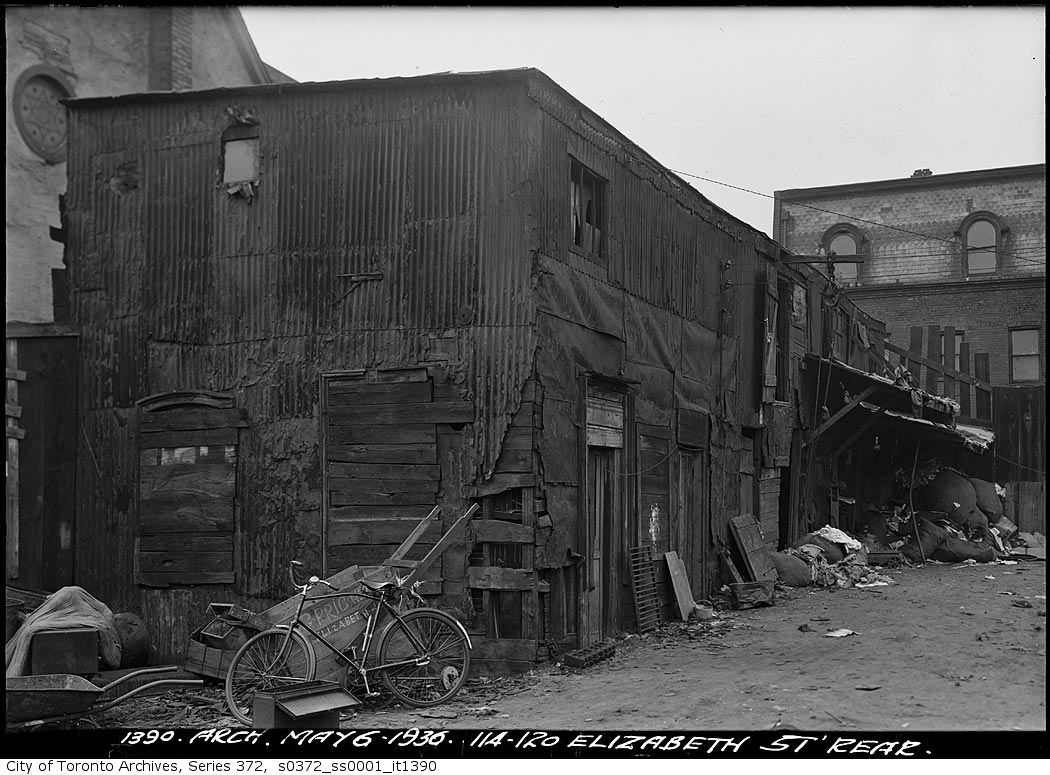
John, Charles, and Thomas Charters lived in the St John's Ward in the late nineteenth century. Directories show that Thomas Charters lived at 193 Elizabeth Street. He also lived at 229 Elizabeth Street. I wondered what the area was like at the time: well, by the 1930s it looks like it was a slum.
Before that I don't think it was particularly wealthy either. It was a poor working-class area according to many accounts; the History to the People blog has some great photos (and is where I got the one above).
Subscribe to:
Posts (Atom)